
The Beatles
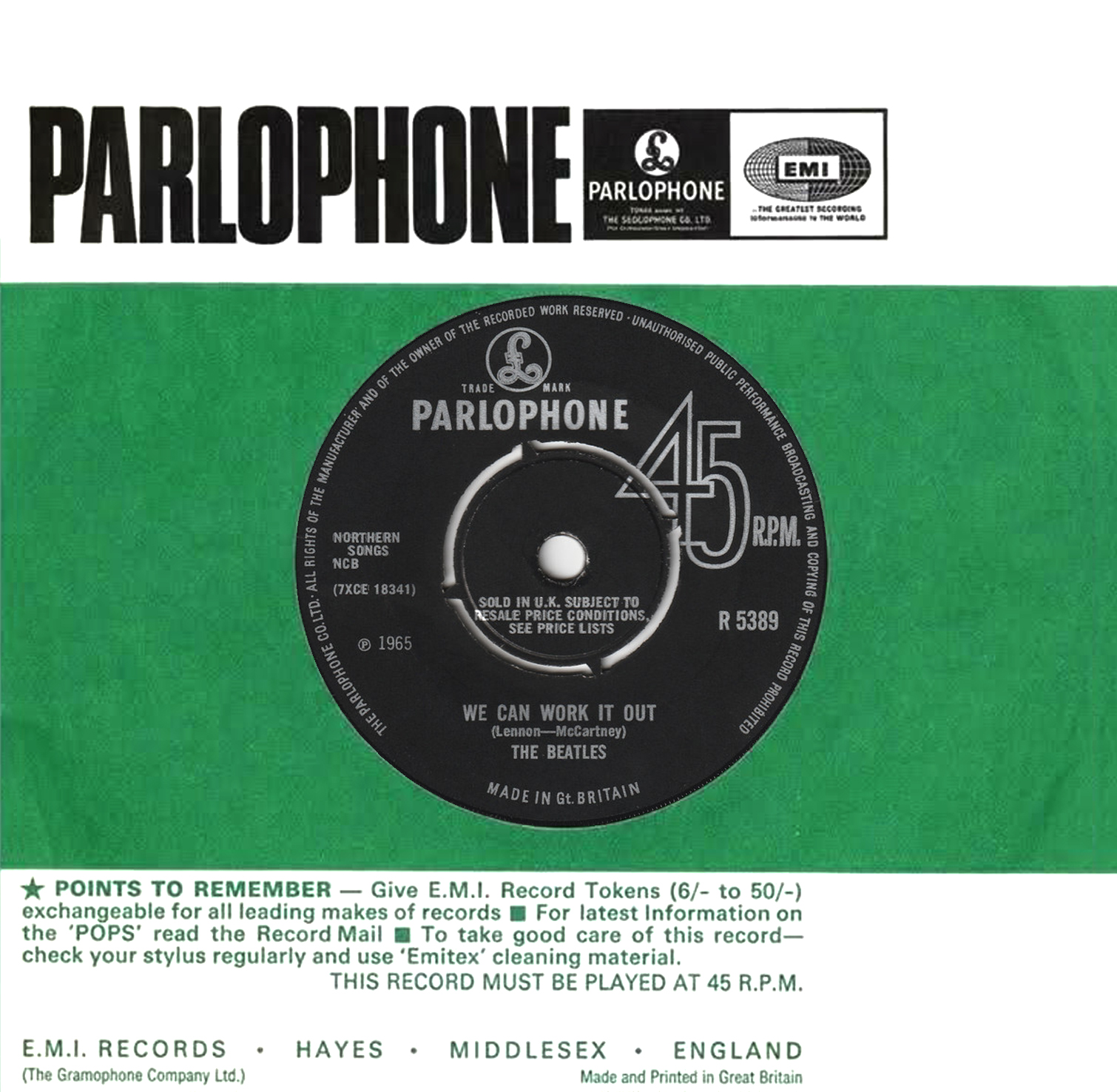
We Can Work It Out / Day Tripper • 1965
Performers

Composition & Lyrics

Recorded
Released
Music Video
Song Facts
- “We Can Work It Out” was released as a double A-side single with “Day Tripper”, the first time two sides of the same single were designated as A-sides in the UK.
- The song, along with its counterpart, was recorded during the Rubber Soul sessions and released on the same day as the album.
- “We Can Work It Out” / “Day Tripper” earned the Beatles their third consecutive Christmas No. 1 in the UK. In the US, where the two sides were charted separately based on radio airplay, “We Can Work It Out” proved more popular, reaching No. 1, while “Day Tripper” peaked at No. 5.
- has said that “We Can Work It Out” was written following an argument with his then-girlfriend, Jane Asher. It is one of three songs from the Rubber Soul sessions to stem from their troubled relationship, alongside “You Won’t See Me” and “I’m Looking Through You”. Together, the songs represent half of Paul’s compositions from the Rubber Soul period, excluding “Wait”, which had been written during the previous album period. Although “Wait” has also been thought to draw on their relationship, this has never been confirmed.
- It was ’s idea to introduce a waltz-like 3/4 time signature at the ends of the bridges, sung by . Paul later explained that the idea did not arise until the song’s recording session on 20 October 1965.
- The idea to use a harmonium also emerged during the first session, giving the song its distinctive sound. The instrument was found hidden away in the studio, reflecting the Beatles’ growing enthusiasm for experimenting with different sounds and instruments in the studio.
- On 28 October 1965, eight days after the song’s first recording session, a “rough remix for TV” was made for The Music of Lennon & McCartney. However, the mix was made too early, as the song was scheduled for further vocals the following day, 29 October, and was subsequently scrapped. A second TV mix was made after the additional session and aired on the Granada TV show, with the Beatles miming to the recording to close the programme.
- Although the song didn’t feature on Rubber Soul, it was included on the US album in June 1966, alongside “Day Tripper” and other Rubber Soul tracks omitted from the US version of the album. Its release on the US album also marked the first appearance of the song in stereo.
- The UK didn't receive a stereo mix of the song until December 1966, when it appeared on . This mix became the standard stereo version and was later used on compilations such as and .
- "We Can Work It Out" and "Day Tripper" were among the first Beatles songs to receive promotional films, allowing the band to promote their music on television without having to appear in person. The films were shot at Twickenham Studios on 23 November 1965, directed by Joe McGrath. Promotional films for "I Feel Fine", "Ticket to Ride" and "Help!" were also recorded that day.
- There are three viewable versions of the “We Can Work It Out” promotional film, although the first version filmed remains officially unreleased. The second version has since been promoted as the song's official music video.
- The song has been covered by numerous artists, including Deep Purple, Stevie Wonder, and Four Seasons, whose rendition featured on the soundtrack of the bizarre Beatles-themed documentary All This and World War II (1976).
Words from Paul McCartney
“It was 1965. Things were not going so smoothly between Jane Asher and me. Everyone has mild arguments where you think, ‘God, I wish they could understand where I’m coming from’ or ‘I wish they could get it! They obviously don’t; they think I’m some kind of idiot or tyrant or something. It was just normal boyfriend-girlfriend stuff where she’d want it one way, I’d want it another way and I would try to persuade her, or she would try to persuade me. Most of the time we got on really well, but there would be odd moments where one or other of us would get hurt.
Time has told me that millions of people go through these little squabbles all the time and will recognise just how common this is, but this particular song was not like that; it was, ‘Try to see it my way!’ When you’re a songwriter, it’s a good thing to just go off and get your point of view in a song, and with a Beatles song, if it’s going to be heard by millions of people, you can spread a good message: ‘We can work it out’. If you wanted to say it in one line, it would be, ‘Let’s not argue’. If you wanted to say it in two lines: ‘Let’s not argue/Listen to me’. Obviously that is quite selfish, but then so is the song.
I started writing the song to try to figure my way out of feeling bad after an argument. It was really fresh in my mind. You can’t write this kind of song two weeks later. You have to do it immediately. Writing a song is a good way to get your thoughts out and to allow yourself to say things that you might not say to the other person.
When we took it to the studio, George Harrison suggested we try the waltz pattern, with suspended triplets, that ended up giving the song a profound sense of friction and fracture.
But the fracture was real, and we did ‘fall apart before too long’.Sadly, Jane and I did break up. And that meant breaking up with her mother too. Margaret Asher was a real mumsy type and, since I’d lost my mum, she had filled that role for me. Now I’d lost a mother for a second time.
Mixes and Versions